Thinking about selling land in Advance? It can look simple on the surface, but buyers often ask more questions about a vacant parcel than they do about a house. If you want to sell with fewer surprises, stronger pricing support, and a smoother process, it helps to understand what matters most in Davie County before you list. Let’s dive in.
Why land sales work differently
Selling land in Advance is not just about acreage. Buyers want to know what they can actually do with the property, how they can access it, and what steps they may need to take before building or improving it.
In Davie County, those answers often come from county zoning, environmental health, mapping, and tax records. The county’s Planning and Development Services handles zoning permits, subdivision review, rezoning, road naming, and ordinance enforcement. That means your parcel’s value is often tied to documented use potential, not just a rough estimate of size.
Why Advance owners should pay attention now
Advance is part of a growing county. Davie County’s population estimate reached 45,383 in July 2024, which was up 6.3% from the 2020 base. The county also issued 250 building permits in 2024.
Those numbers matter because growth can shape how buyers view land. Parcels with stronger road access, utility context, or location near growth corridors may attract a different kind of interest than more isolated tracts. Davie County’s long-range planning documents also point to development patterns along major transportation corridors and in areas that may be ready for more infrastructure investment.
What buyers want to know first
Most land buyers in Advance are trying to reduce uncertainty. They want to know whether the property fits their intended use before they commit time and money to due diligence.
That usually means your listing should answer practical questions such as:
- Where are the boundaries?
- Is there recorded access?
- What is the zoning?
- Is the parcel in a flood-related area or watershed-protected area?
- Is there a survey or recorded plat?
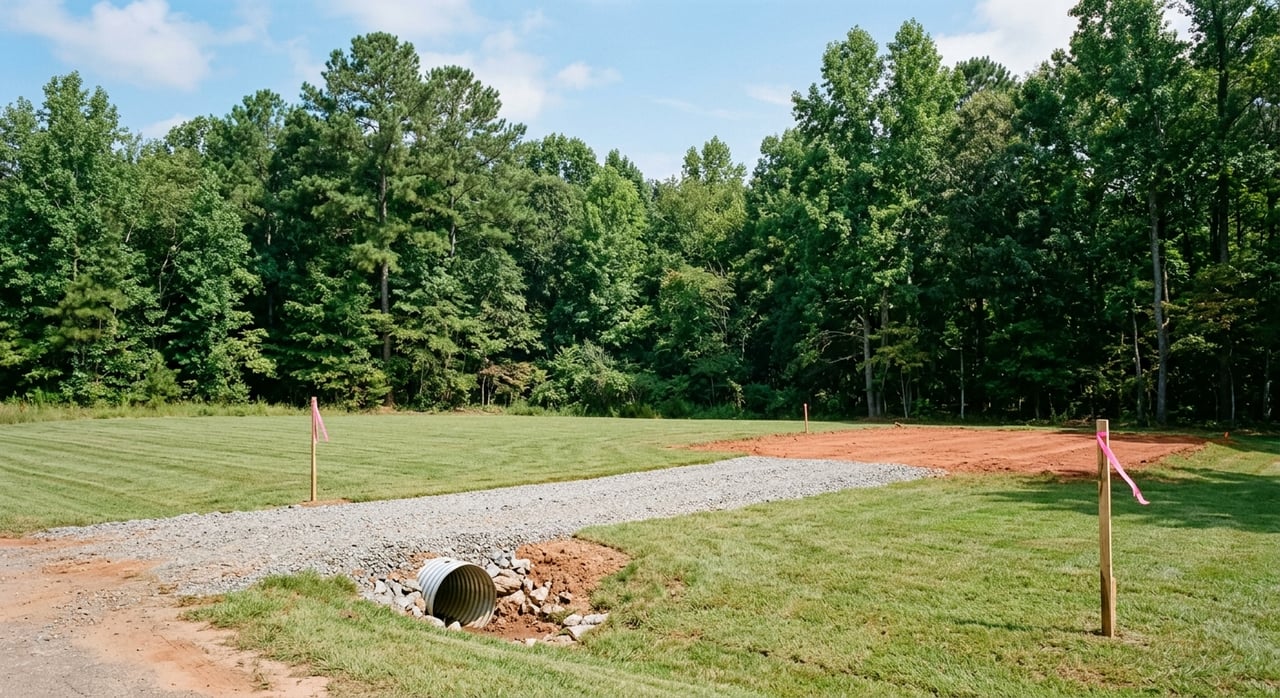
- Has the property had any septic, well, or other site work started?
- If access touches a state road, is a driveway permit likely needed?
The more of those answers you can document upfront, the easier it becomes for a buyer to understand the opportunity.
Key documents to gather before listing
A strong land listing in Advance should be document-first. Buyers tend to move faster when the important records are easy to review and organized from the start.
Here are the most useful items to pull together before the property goes live:
- Survey or recorded plat
- Tax PIN
- Deed references
- Easement or right-of-way documents
- Septic records, if available
- Well records, if available
- Access details
- Flood and soil context
- Any prior permit history tied to the parcel
Davie County’s Register of Deeds offers land-record search tools, and the county GIS system provides parcel mapping and related layers. Even so, the county is clear that GIS data is not a land survey and should be verified by a North Carolina licensed surveyor.
Why a survey helps so much
One of the most common land-sale problems is boundary uncertainty. A buyer may love the parcel, then hesitate because they are not fully sure where the lines fall, how the tract lays out, or whether a proposed use fits.
That is why a current survey or recorded plat can be so helpful. Davie County’s GIS is useful for research, but it is not a substitute for a survey. If you want to reduce confusion and support your asking price, clear boundary evidence is one of the best places to start.
Septic, well, and site readiness matter
For many buyers, the biggest question is simple: can this lot support the use they have in mind? In Davie County, septic and well planning can be a major part of that answer.
The county’s environmental health requirements for septic and well applications are detailed. For septic and well applications, the county requires a site plan or survey plat, marked corners and property lines, a staked footprint, a cleared work area, and marked utilities. If soils evaluation is needed, backhoe pits are also required, and incomplete applications are returned.
The county also notes that a permit with a site plan is valid for 60 months, while a complete plat has no expiration. If your parcel already has documentation in place, that can be useful to a buyer. But it does not automatically guarantee the lot will support every future plan or layout.
Buildability is not the same as possibility
This is where many sellers get tripped up. A past permit, old test, or verbal understanding does not always answer a buyer’s full buildability question.
For example, septic approval does not by itself guarantee a lot is ready for any home design a buyer wants. The parcel still has to match the intended use, the footprint, and the actual site conditions. In other words, buyers are not just purchasing land. They are purchasing confidence in what that land can support.
Access can affect value and timing
If your parcel connects to a state-maintained road, access may involve more than just pointing out the frontage. The North Carolina Department of Transportation says a driveway permit may be required for development, redevelopment, expansion, or changes in access.
NCDOT also says there is no application fee, and simple requests are often processed in about four weeks or less. Just as important, building permits may be withheld until driveway access approval is resolved. If your property’s access is straightforward, that is worth highlighting. If it is not yet settled, it is better to be clear about that from the start.
Flood and watershed issues deserve attention
Not every land buyer asks about flood risk right away, but serious buyers usually get there. Davie County includes both flood damage prevention and watershed protection in its ordinance framework, and the county GIS points users to flood risk information, flood maps, and NRCS soil data.
The county’s floodplain reference also says development in special flood hazard areas requires a floodplain development permit and an elevation certificate before new construction begins. That does not mean a parcel has no value if flood or watershed rules apply. It does mean those issues can shape price, design flexibility, and buyer expectations.
Taxes and holding costs in Davie County
If you are deciding whether to sell now or hold the land longer, carrying cost matters. Davie County completed its 2025 revaluation using January 1, 2025 market values and set the 2025-26 county tax rate at $0.6486 per $100 of valuation.
Some parcels may also fall within the Advance Rural Fire Protection district, which carries a levy of $0.02438 per $100 valuation. Tax bills go out after July 1 and are payable from September 1 through January 5. For owners who are comparing timing options, that billing cycle can be an important part of the decision.
How to price land in Advance
Land pricing is rarely about one simple number per acre. Buyers compare use potential, access, documentation, utility path, and risk. A smaller parcel with cleaner documentation and easier development potential may draw more interest than a larger tract with major unknowns.
When pricing land in Advance, it helps to think about the story the parcel can support. Is it best presented as a homesite, estate parcel, farm tract, or long-term investment hold? That positioning can influence both your marketing strategy and the kind of buyer you attract.
How to make your listing stronger
A strong land listing should do more than mention acreage and road frontage. It should help buyers quickly understand what is known, what still needs verification, and what steps may come next.
Here are practical ways to improve your listing presentation:
- Include a survey or recorded plat when available
- Show the tax PIN and deed references
- Note any known easements or right-of-way details
- Share prior septic or well records if they exist
- Clarify road access and whether state access rules may apply
- Provide flood or watershed context when relevant
- Explain the likely use case in simple language
This kind of preparation can reduce back-and-forth, help defend your price, and make your property feel more credible to serious buyers.
What local expertise adds
Land sales in Advance often involve details that do not come up in a standard home sale. Zoning, environmental health, mapping, access, and county records can all shape buyer confidence. That is why local guidance matters.
A well-prepared listing is not about overpromising. It is about presenting the parcel clearly, organizing the facts, and helping buyers understand the path from interest to due diligence. When that work is done well, your land has a better chance to stand out for the right reasons.
If you are getting ready to sell land in Advance, the best first step is usually to organize what you know, identify what still needs verification, and build a clear plan for pricing and presentation. For local guidance and a practical selling strategy, connect with Karen Swicegood.
FAQs
What documents help when selling land in Advance, NC?
- The most useful documents usually include the survey or recorded plat, tax PIN, deed references, easements or right-of-way documents, septic or well records, access details, and any flood or soil context tied to the parcel.
Do you need a survey to sell vacant land in Davie County?
- A survey is not always legally required to list land, but it helps a great deal because Davie County states that GIS parcel data is not a survey and should be verified by a North Carolina licensed surveyor.
Does septic approval guarantee a lot is buildable in Advance?
- No. Davie County still requires site-specific review, and the parcel must match the intended use, footprint, utilities, and actual site conditions.
How do access permits affect land sales in Advance, NC?
- If the parcel needs access to a state highway, an NCDOT driveway permit may be required, and building permits may be delayed until access approval is resolved.
When are property taxes due on land in Davie County?
- Davie County sends tax bills after July 1, and payments are due from September 1 through January 5.
Why do flood and watershed rules matter when selling land in Advance?
- Flood and watershed rules can affect how a parcel is used, what permits may be needed, and how buyers evaluate risk, cost, and development flexibility.